
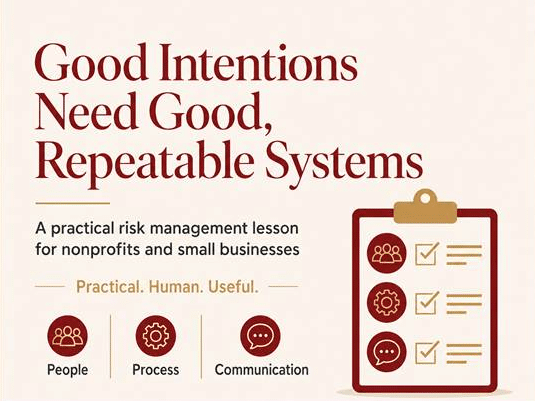
For many nonprofits and businesses, the mission is personal. People show up because they care. They give their time, energy, experience, and heart to serve something bigger than themselves. Still, even the best intentions need structure.
Recently, ThompsonBaker had the opportunity to assist a local organization in building a professional volunteer guide focused on helping its team share important information consistently. The greater need was to help the people running the organization stay informed, aligned, and prepared — no matter who was working, who was new, or who had the most experience.
In many organizations, important knowledge often lives in one person’s head. One person knows the history. One person knows what happened last week. One person knows which situations require extra caution.
That may work for a while, but it is not a reliable system. When information is not documented, shared, or repeated consistently, preventable problems can become claims.
Good intentions need good, repeatable systems.
Claims Often Reveal Patterns
One of the most practical pieces of risk management is also the simplest: look at what keeps happening.
Are the same types of claims or incidents happening more than once? Are near misses being discussed but not documented? Are procedures handled differently depending on who is present?
When claims repeat, it is often a sign that the organization may not just have a “people problem.” It may have a process problem.
That is where redundancies come in.
Redundancy does not mean unnecessary paperwork. It means creating checks and balances so important information does not depend on one person, one conversation, or one memory.
For a nonprofit, that may mean written procedures for donations, events, transportation, client interactions, facility access, volunteer onboarding, or incident reporting.
For a business, it may mean backup procedures for client service, claims reporting, financial controls, employee training, or customer communication.
Different organizations face different risks, but the principle is the same: if a task matters, the process should not live only in someone’s memory.
Practical Risk Management Starts Before the Claim
At ThompsonBaker, we believe risk management should be practical, human, and useful.
Insurance is important, but risk management begins long before a claim is filed. It begins in everyday systems that help people do the right thing consistently.
A few helpful questions every organization should ask:
- What types of claims or incidents happen most often?
- Are those incidents isolated, or do they reveal a pattern?
- Where does critical knowledge currently live?
- What happens if the person with that knowledge is unavailable?
- Are procedures written clearly enough for someone new to follow?
- Are important concerns documented and shared between team members?
- Are there checks and balances before small issues become larger problems?
These questions are not about blame. They are about prevention.
When organizations take the time to review what is happening, identify patterns, and strengthen their procedures, they protect more than their insurance program. They protect their people, their mission, their reputation, and the community they serve.
Consistency Protects Everyone
In the case of the volunteer guide, one of the most meaningful pieces of feedback was that the final product felt professional and organized. That matters.
A well-organized guide creates a common language. It helps people understand expectations. It gives leadership a tool for training. Most importantly, it helps reduce the chance that something important gets missed.
After more than 100 years serving our community, ThompsonBaker understands that strong protection is not built on insurance policies alone. It is also built through preparation, communication, and practical systems that help prevent problems before they happen.
If your organization has experienced recurring claims, repeated incidents, or operational gaps, do not only ask, “What happened?”
Ask, “What could we put in place to reduce the chance of this happening again?”
The answer may be a written procedure, a checklist, a second person reviewing a key step, better training, stronger documentation, or a clearer handoff process.
Small changes can make a meaningful difference.
At ThompsonBaker, we are committed to helping nonprofits and businesses think through risk in a practical and useful way. If your organization would benefit from a practical review of its risk management procedures, our team would welcome the opportunity to help.